
A Free Rig is a soft-plastic setup with a sinker that slides along the fishing line through an attachment eye. The hook is tied to the end of that same line. There is no swivel and separate leader dividing the sinker from the bait, as on a conventional Carolina rig.
Cast to the edge of a point and let the rig fall on controlled slack. The sinker reaches bottom, but the plastic can still be settling behind it. That last stretch of the fall is the presentation you are building: a bait descending without being fixed directly to the weight.
Here is how to build that presentation with the right connection, hook, and soft plastic. You will find FishTrailCo options for compact finesse fishing and larger bass setups, plus retrieves that help you keep track of the fall and spot a bite.
What Makes a Free Rig Different?
The defining feature is movement of the line through the sinker's attachment eye. Before tying on the hook, pass the line through that eye. Once assembled, the weight must be able to slide without gripping the line or being permanently attached to the hook.
That is different from a Jika rig, where metal hardware connects the sinker beside the hook. It also differs from a drop shot, where the hook is tied above a sinker on the tag end. All three can be fished near bottom, but their connection order determines their behavior.
Step-by-Step Free Rig Assembly
- Choose a sinker with a suitable running eye and inspect the connection surface.
- Pass the end of your line or leader through the sinker eye. Keep the line out of any gripping slot.
- Tie the hook to the end of that same line with a knot suitable for your line and hook.
- Wet and tighten the knot correctly, then trim the tag according to the knot's requirements.
- Slide the sinker toward the knot and back up the line. Confirm that it moves freely and does not swallow, pinch, or catch the knot.
- Rig the plastic straight on the hook, leaving enough gap for the body to compress.
- Check the hook point, sliding connection, and line for damage before casting.


Do not add a swivel and a measured leader between the sinker and hook for the standard setup described here. That would create a different arrangement, closer to a Carolina rig. A braid-to-leader connection above the rig is separate from that distinction.
Is a Bead or Stopper Necessary?
The basic rig works without either. If you add a knot protector, leave the sinker free to slide. Keep the setup simple and check the knot after working abrasive cover.
If a sinker eye repeatedly traps the knot, change the connection rather than treating a snagging eye as normal. Smooth line movement is central to the presentation.
How the Free Rig Falls
The sinker and bait have different mass, shape, and resistance in water. When the line can move through the eye and you avoid pulling everything tight, the weight can move ahead of the plastic. The amount of separation depends on the bait, hook, line, sinker, water movement, and cast angle.
A bulky creature bait may resist the fall differently from a compact, dense plastic. A heavier hook changes the bait's descent. A strong crosswind can create a belly in the line, while too much tension can draw the bait toward the sinker. That spacing changes throughout the fall; watch the rig rather than trying to maintain a set distance.
You can repeat the falling presentation by lifting the rig and allowing it to settle again. You can also drag it, but a continuous tight-line drag emphasizes bottom contact rather than the separated fall. Use the lift-and-fall to show fish a descending bait, and the drag to search for a productive bottom change.
Free Rig vs. Texas, Carolina, Jika, Drop Shot, and Ned
| Rig | Main difference from a Free Rig | Practical reason to choose it |
|---|---|---|
| Texas | Line passes through a bullet sinker's body; an unpegged sinker can slide ahead of the bait | Streamlined rigging for vegetation and cover |
| Carolina | Swivel and separate leader establish spacing | Longer drags over broad bottom areas |
| Jika | Weight attached beside the hook through hardware | Compact, jointed presentation with direct weight changes |
| Drop shot | Hook tied above terminal sinker | Adjustable spacing above bottom and target control |
| Ned | Plastic mounted on a small jig head | Simple compact presentation over suitable bottom |
A Free Rig allows the spacing between bait and weight to change during the fall. A Carolina rig uses a separate leader of fixed length; a drop shot sets the distance between the hook and sinker. Even with a weedless hook, an exposed sinker or connection can still snag.
Choose the Free Rig for its falling presentation. Choose a Texas rig when getting a streamlined bait through dense grass is the priority.
Choose the Right Free Rig Weight
A Smooth, Closed Running Eye
For a straightforward Free Rig, start with a sinker that has a smooth, closed attachment eye large enough for the line to pass through freely. Inspect the eye for rough edges and check that it does not trap or wedge against the hook knot.
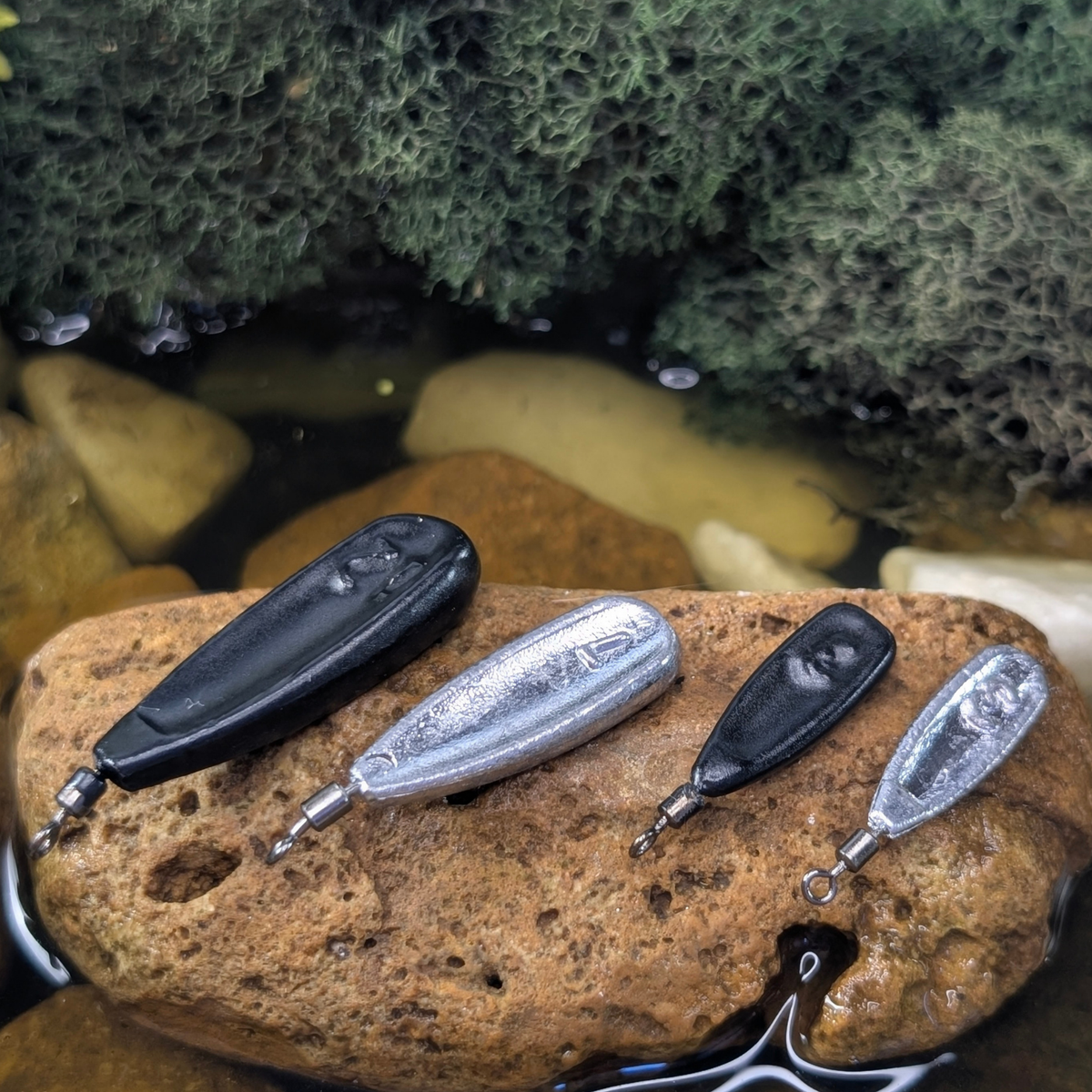
FishTrailCo Slim Teardrop Drop Shot Weights with Swivel provide a slim body and swivel eye. Although their standard product instructions describe tying them below a drop-shot hook, the closed eye can also serve as a running connection when the line passes through freely and the knot remains clear.
The connection method is what changes: for a drop shot you tie the sinker to the tag end; for this Free Rig you thread line through its eye before tying the terminal hook. Test sliding movement with your actual line and knot before casting.
Fastach-Style Connections
FishTrailCo Fastach Jika & Free Rig Weights are also listed for both presentations. For their Free Rig configuration, the line passes through the connector before you tie on the hook; the weight must remain free to slide.
Check that the line stays inside the working loop and cannot enter the connector's entrance or catch on a wire junction. The quick-change procedure used to rotate a Fastach weight onto a Jika hook eye should not be assumed to work identically on a sliding line.
A conventional closed eye makes a simple first Free Rig. With the Fastach version, make the same sliding check before your first cast.
Why a Pinch Clip Is Different
A quick-change drop-shot line clip is designed to hold the line in a narrow slot. That is useful on a drop shot, but gripping the line prevents the sliding movement required here. Do not pull the line into a pinch slot and call the result a Free Rig.
Likewise, Fishball and Eccentric removable-wire weights normally build a Cheburashka rig. Their standard hook connection does not reproduce a freely sliding sinker. Our Cheburashka Rig Guide explains that separate system.
Weight Size: Start with Control, Then Watch the Fall
The best weight is not automatically the lightest. A sinker must reach the target area and remain controllable in wind or current. A sufficiently heavy sinker can still descend ahead of a slower-falling bait, provided the eye and line allow movement.
| Trial weight | Application to explore | What to observe |
|---|---|---|
| Around 1/8 oz | Shallow, calm water and compact plastics | Can you cast and identify the sinker's arrival? |
| 3/16–1/4 oz | General points, edges, and moderate depths | Does the bait continue settling after the sinker? |
| 3/8 oz | Added depth, wind, current, or bait resistance | Is the rig controllable without continuous tight tension? |
| 1/2 oz and heavier | Conditions requiring stronger depth control | Does it wedge, bury, or overpower the intended retrieve? |
On a reservoir, start around points and edges in eight to twenty feet, then follow the fish shallower or deeper. Let wind, current, and line control guide the sinker choice. Check the selected variant for its ounce and gram labels.
Hooks and Weedless Rigging
Offset worm hooks work well for Texas-style rigging of a Free Rig plastic. Match the gap to the compressed body and place the point where the bait can remain straight. A hook that bends the plastic into an arc can change both movement and hook-point clearance.
Vanfook WORM55R Red Wide Gap Offset Hooks provide options for thicker worms, creatures, and compact swimbaits. Select wire and size to match the rod, line, and cover rather than choosing the biggest hook simply because bass are the target.
For small plastics, Tournament JIG-RIG Offset Hooks WMV-32SB offer compact numbered sizes. Their enlarged eye is intended to provide mobility on articulated rigs; for a Free Rig, also check that your sinker eye cannot bind with the hook knot.
The bait may be rigged with a lightly skin-hooked point for scattered cover. In open water, an exposed point is another option, but it will contact structure more easily. Hookset force needs to match the wire and amount of plastic protecting the point.
Soft Plastics for the Free Rig
A creature bait provides body area and appendages that can respond during the fall. Bait Breath U30 Mosya 3-inch is a compact option. Virtual Craw 3.6-inch gives you a craw profile to compare around bottom structure.
TurboRib 2-inch and TurboRib 3-inch offer a curly tail for lifts, short swims, and a different falling profile. Slim Shad 3.3-inch provides a slim baitfish shape with a paddle tail. Choose a hook that fits the bait body, then watch how the rigged plastic settles on slack line.
For background on our two main soft-bait styles, read Paddle Tail vs. Ribbed Grub.
Color Selection
Begin with a color you trust for the water and forage. Natural tones are a useful first trial in clear water. Dark silhouettes, pearl, or brighter accents give alternatives when visibility changes. Do not assume the rig requires a specific color or that the brightest bait is always best in stained water.
How to Fish a Free Rig
Give the Fall Room to Happen
After the cast, follow the fall with your rod tip instead of pulling the line tight. Leave enough slack for the sinker to lead and the plastic to settle behind it. Keep your eyes on the line: a sideways twitch or an unexpected stop can be the first sign that a bass has picked up the bait.
When you feel the sinker settle, resist the urge to move it immediately. Give the plastic time to finish falling. Deeper water and a slower-falling bait call for a longer wait; a shallow cast may need only a brief pause.
Lift, Settle, and Pause
Lift the rig a short distance, follow the fall, and pause again. This repeats the sinker-first opportunity without making another cast. Begin with modest lifts around structure. Adjust the movement if bass respond to a faster presentation or the sinker continually catches.
Drag to Find Bottom Changes
Pull the sinker slowly with the rod and feel your way across the bottom. Gravel can produce crisp little ticks; silt feels softer and may load the rod before the weight comes free. Find a change, stop, and add a short lift followed by a pause. The drag finds the spot; the fall gives the bait another chance to get eaten.
For more detail on reading structure, see our Bottom-Contact Fishing Guide.
Detect the Bite Before Setting
Bites may happen while the plastic settles, not only after it reaches bottom. Look for the line moving sideways, accelerating, or stopping unexpectedly. You may feel a tap or added weight when you regain contact.
Gather slack before setting the hook. Use a controlled hookset matched to the hook wire and rigging. Light finesse gear and a small hook require a different approach from a thicker offset hook with its point buried in a bulky body.
Conditions Worth Exploring
Try a Free Rig around outside grass edges, points, sparse brush, rock transitions, and open lanes near docks. It is especially worth testing when bass respond to a falling plastic or when you want to compare a variable-separation presentation with a familiar Texas rig.
In spring, examine staging areas and nearby depth changes. Through summer, try grass edges and deeper structure that hold forage. In fall, compare creature and baitfish profiles as bass feeding patterns shift. When the bite gets tough, slow the retrieve or downsize. When bass chase, cover more water.
Around thick grass, reconsider whether the connector and sinker shape are appropriate. Over sharp rock or shell, inspect the running section of line regularly. Over mud, shorten drags and compare sinker shapes so the rig does not spend every pause buried in silt.
Rod, Reel, and Line
Both spinning and baitcasting tackle can fish a Free Rig. Choose a rod rated for the combined sinker and bait weight, with enough power for the hook and cover. A sensitive tip helps with line control, but hook penetration and fish control still depend on the whole setup.
Four Recommended Starting Setups
General bass: a Slim Teardrop weight labeled 1/4 oz (7g), WORM55R 2/0, and Mosya 3-inch. Thread the line through the closed swivel eye and compare short lifts with longer pauses.
Compact finesse: a Slim Teardrop weight labeled 1/8 oz (3g or 4g, as selected), WMV-32SB #2, and TurboRib 2-inch. Use suitable spinning tackle for short lifts and controlled pauses.
More depth or wind: a Slim Teardrop weight labeled 3/8 oz (10g), WORM55R 3/0, and Virtual Craw 3.6-inch. Let the bait settle after the sinker touches down, then start the next lift.
Simple starting box: one proven hook-and-plastic combination with two closed-eye weights labeled 3/16 oz and 1/4 oz. Begin with the same cast and retrieve, changing only weight to understand control and the fall.
Build these combinations from individual products. Match the rod and line to the hook and cover, then use the assembly checks above before casting.
Common Free Rig Mistakes
- Attaching the sinker to the hook instead of letting it slide along the line.
- Pulling the line into a drop-shot pinch slot.
- Keeping constant tight tension during the initial fall.
- Leaving so much slack that you cannot recognize line movement.
- Expecting a fixed leader length or guaranteed bait-to-weight separation.
- Using a sinker eye that catches the knot or damages the line.
Free Rig FAQ
Can I use a drop-shot weight for a Free Rig?
Yes, if it has a suitable smooth running eye. A line-gripping pinch clip is not equivalent. Evaluate the actual connection, not just the product category.
Is a Free Rig just an unpegged Texas rig?
They share a sliding-weight concept, but the Free Rig line passes through an attachment eye outside the sinker body. Shape and line control change how the components interact.
How long should the leader between hook and weight be?
There is no fixed leader between them in the standard Free Rig. The weight slides on the same line that terminates at the hook. A separate measured leader belongs to a different assembly.
Can I fish it in shallow water?
Yes. Reduce weight or adjust the bait and retrieve as needed. Shallow water leaves less distance for the fall to develop, so do not expect the same presentation as on a deeper cast.
Can I use spinning tackle?
Yes. Match the rod, line, hook, and total lure weight. Baitcasting gear is another option for larger plastics, heavier hooks, or stronger cover.
Does heavier weight ruin the free fall?
Not automatically. Separation depends on the complete setup and line tension. Use enough sinker weight for control and evaluate the bait's fall rather than following a universal light-weight rule.
Shop Free Rig Essentials
Start with Slim Teardrop swivel weights, Fastach weights, WORM55R hooks, WMV-32SB hooks, Mosya 3-inch, and Virtual Craw 3.6-inch.
Keep the connection sliding, give the fall room to develop, and watch the line. To compare the hanging-sinker alternative, read the companion Jika Rig guide, or browse Jika & Free Rig Weights.